One of the first questions business owners ask about artificial intelligence is also one of the biggest misconceptions: "We'd love to use AI, but we probably can't afford it." The reality is quite the opposite. In many cases, implementing AI costs less than hiring one part-time employee, yet it can automate work that would otherwise consume dozens of hours every month. Whether you're a local contractor, law firm, dental office, retailer, manufacturer, or professional services company, AI has become one of the most affordable technology investments available to small businesses.
The better question isn't "How much does AI cost?"
It's "How much is it costing my business not to use AI?"
Why Small Businesses Are Investing in AI
Small business owners wear many hats.
On any given day, you're likely:
Answering phone calls
Returning emails
Following up with leads
Posting on social media
Scheduling appointments
Sending invoices
Managing employees
Updating your website
Responding to customer reviews
These are necessary tasks—but they don't always generate revenue. AI helps automate much of this repetitive work, giving owners and employees more time to focus on serving customers and growing the business. According to the U.S. Census Bureau, AI adoption continues to rise among U.S. businesses, while the Federal Reserve reports that nearly half of small businesses already use AI in some capacity, with many more planning adoption in the near future.¹²
Understanding AI Costs
One reason AI seems confusing is that there isn't a single price. Instead, AI investments generally fall into four categories.
1. AI Software Subscriptions
Many AI tools are cloud-based software paid monthly.
Examples include:
AI writing assistants
Customer chat systems
Meeting transcription
Email automation
Marketing tools
CRM enhancements
Typical investment:
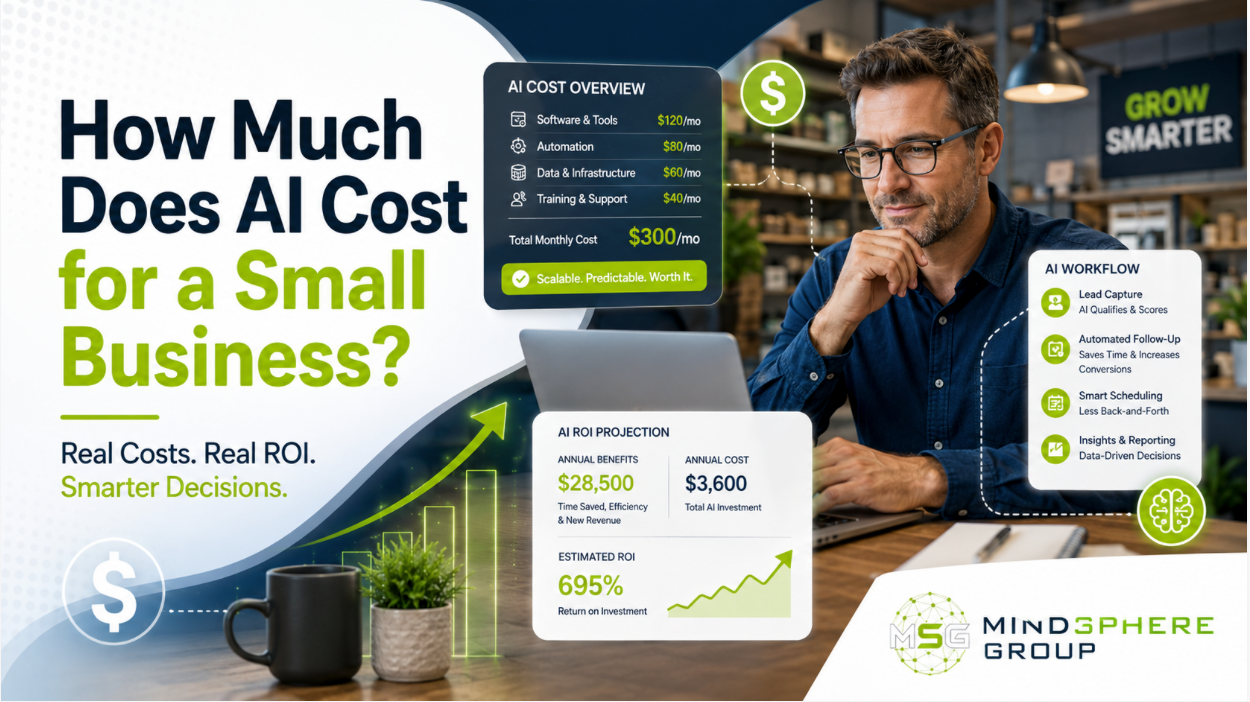
$20–$300 per month depending on the software and number of users. For many businesses, this is comparable to other software subscriptions they already use.
2. AI Customer Service Tools
Businesses that receive frequent customer inquiries often benefit from:
AI receptionists
Website chat assistants
Missed-call text back
Appointment scheduling
Customer support automation
Typical investment:
$100–$1,000+ per month, depending on call volume and features. For companies that rely on incoming leads, even one additional customer each month may offset the entire cost.
3. Workflow Automation
Automation connects the software you already use.
Examples include:
Website → CRM
CRM → Email
Forms → Scheduling
Accounting → Reporting
Marketing → Analytics
Rather than employees manually transferring information between systems, AI and automation handle it automatically. Implementation costs vary depending on complexity, but the time savings often compound every week.
4. AI Strategy and Implementation
This is where companies like MindSphere Group add value. Buying software is easy. Knowing which tools actually improve your business is the hard part.
Implementation often includes:
AI readiness assessment
Process evaluation
Workflow mapping
Tool selection
Integration
Employee training
Ongoing optimization
A thoughtful implementation helps businesses avoid spending money on tools they'll never use.
Comparing AI to Hiring Another Employee
Imagine hiring an administrative assistant.
Typical annual costs may include:
Salary
Payroll taxes
Benefits
Vacation
Training
Equipment
Office space
The total cost can easily exceed tens of thousands of dollars per year. AI doesn't replace employees—but it can reduce repetitive administrative work that otherwise requires additional staffing. Think of AI as giving every employee extra hours in the day. What Is the ROI of AI? Return on investment depends on how AI is used. Businesses typically see value in four areas.
Time Savings
If AI saves five hours every week, that's more than 250 hours annually.
Those hours can be redirected toward:
Sales
Customer service
Business development
Employee training
Strategic planning
Better Customer Response
Customers expect quick answers.
AI helps businesses respond immediately through:
Website chat
Text messaging
Email automation
AI receptionists
Faster responses generally lead to higher conversion rates.
Marketing Efficiency
AI dramatically reduces the time needed to produce:
Blog articles
Social media posts
Email newsletters
Google Business Profile updates
SEO content
Businesses can market more consistently without significantly increasing costs.
Improved Operations
AI also reduces repetitive administrative work by automating:
Data entry
Scheduling
Customer follow-up
Reporting
Internal documentation
Small improvements across multiple processes often create significant long-term savings.
The Hidden Cost of Waiting
Many businesses delay adopting AI because they assume they'll revisit it "next year."
Meanwhile, competitors begin:
Responding faster
Publishing more content
Following up automatically
Ranking higher in Google
Capturing more online reviews
Providing better customer experiences
The longer businesses wait, the wider that competitive gap can become.
Start Small, Then Grow
One misconception is that AI requires a complete business overhaul. It doesn't. Most companies benefit from starting with one or two projects.
Examples include:
AI Website Chat
Answer questions and capture leads 24/7.
Automated Lead Follow-Up
Respond instantly to new inquiries.
AI Receptionist
Never miss another phone lead.
Content Creation
Publish blogs, newsletters, and social media more consistently.
Workflow Automation
Eliminate repetitive manual work between software systems. Once these foundations are in place, businesses can expand automation over time.
Choosing the Right AI Partner
There are thousands of AI tools available today. Not all of them belong in your business. At MindSphere Group, we focus on practical implementation—not hype.
Our team helps businesses:
Identify high-value automation opportunities
Select the right AI tools
Integrate systems
Train employees
Improve customer experience
Increase efficiency
Measure business results
Technology should support your business goals—not complicate them.
Frequently Asked Questions
Is AI affordable for small businesses? Yes. Many AI tools start at less than the monthly cost of a cell phone plan, and automation often produces measurable time savings. Do I need multiple AI subscriptions? Not necessarily. Many businesses begin with one or two carefully selected tools before expanding. Can AI work with my current software? Often, yes. Modern AI platforms integrate with many CRM systems, accounting software, scheduling platforms, and marketing tools. What's the biggest mistake businesses make? Buying software before developing a strategy. Successful AI adoption starts with understanding business processes, not technology.
The Bottom Line
Artificial intelligence is no longer reserved for large corporations with massive IT budgets. Today's AI solutions are affordable, practical, and designed to help small businesses compete more effectively. Whether your goal is to save time, improve customer service, generate more leads, or streamline operations, AI can deliver measurable value without requiring a massive investment. The question isn't whether you can afford AI. It's whether you can afford to ignore it. Ready to Discover What AI Could Save Your Business? Every business is different, and there's no one-size-fits-all AI solution. That's why MindSphere Group begins with understanding your goals, your workflows, and your biggest challenges. We'll help you identify the automation opportunities that deliver the greatest return on investment—without paying for tools you don't need. Contact MindSphere Group today for a free AI consultation and discover how affordable AI can help your business save time, reduce costs, improve customer service, and grow with confidence.
References
U.S. Census Bureau. Business Trends and Outlook Survey (BTOS): Artificial Intelligence Use by U.S. Businesses (2025–2026).
Federal Reserve Banks. 2025 Small Business Credit Survey: AI Adoption Among Small Businesses.
Goldman Sachs. 10,000 Small Businesses Voices Survey (2026).
U.S. Small Business Administration. Artificial Intelligence Resources for Small Businesses.
U.S. Chamber of Commerce. How Small Businesses Are Using AI to Improve Productivity.