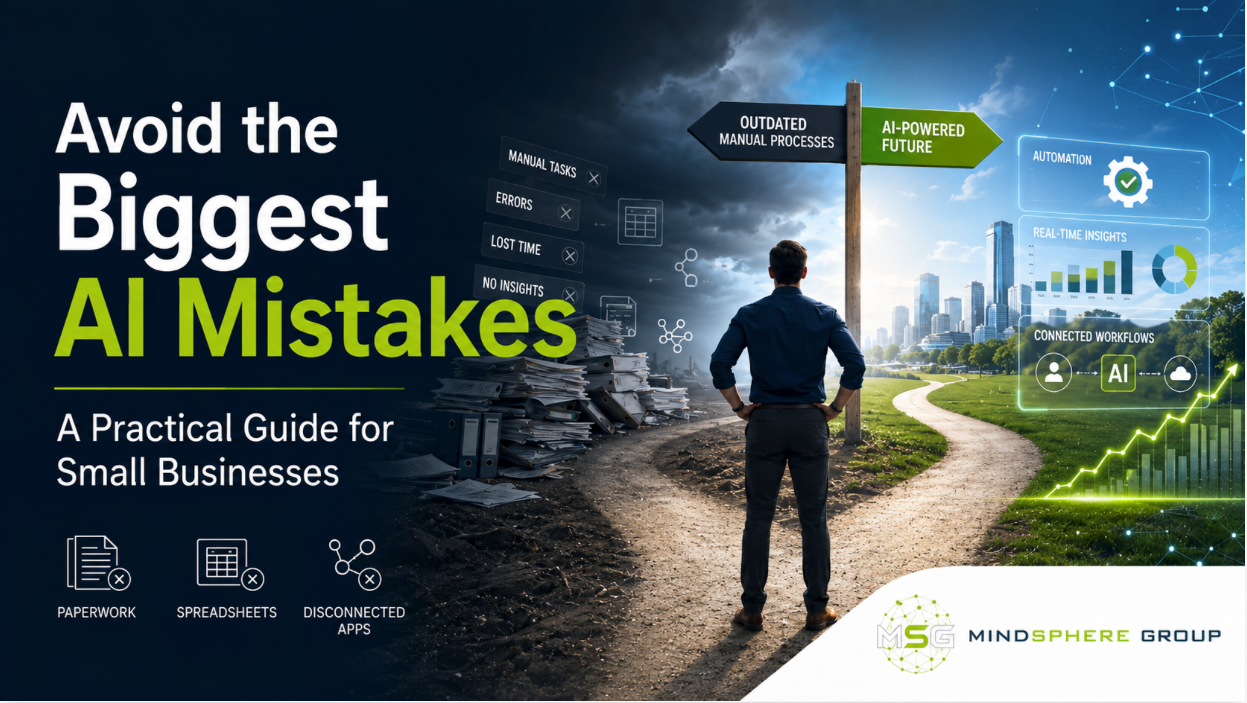
Artificial intelligence is quickly becoming one of the most valuable tools available to small businesses. From automating customer service and marketing to streamlining operations and improving decision-making, AI has the potential to save time, reduce costs, and drive growth. Yet many business owners dive into AI expecting instant results—only to become frustrated when the technology doesn't deliver on the hype. The problem usually isn't AI itself. It's the way businesses approach it. According to the U.S. Census Bureau, AI adoption continues to increase across businesses of all sizes, while research from the Federal Reserve and Goldman Sachs shows many small businesses are experimenting with AI but haven't fully integrated it into daily operations.¹²³ The companies seeing the greatest return aren't buying the most AI software. They're implementing AI strategically. Here are the biggest mistakes we see—and how your business can avoid them.
Mistake #1: Buying AI Tools Without a Strategy
One of the most common mistakes is signing up for multiple AI subscriptions simply because they're popular. Business owners hear about ChatGPT, Microsoft Copilot, Claude, Gemini, or dozens of other AI platforms and assume they need them all. Before long they're paying for software that employees rarely use.
Instead, start by asking:
Which tasks consume the most time? Where are we losing customers? What repetitive work frustrates employees? Which processes slow down growth? Once you understand the problem, selecting the right AI tools becomes much easier. Technology should support your business strategy—not become your strategy.
Mistake #2: Trying to Automate Everything at Once
AI can automate hundreds of business processes. That doesn't mean you should automate all of them immediately. Successful businesses usually begin with one or two high-impact improvements such as:
AI website chat
Missed-call text back
Lead follow-up
Appointment scheduling
Marketing content
Email automation
After employees become comfortable, additional automation can be introduced gradually. Small wins build momentum.
Mistake #3: Expecting AI to Replace Employees
This may be the biggest misconception surrounding AI. Artificial intelligence excels at repetitive tasks.
People excel at:
Building relationships
Solving problems
Negotiating
Creating trust
Making judgment calls
Delivering exceptional customer service
The most successful businesses use AI to support employees—not replace them. Think of AI as giving every employee an assistant.
Mistake #4: Ignoring the Customer Experience
Some businesses become so focused on automation that they forget why customers choose them. If AI makes it difficult to reach a real person... If customers can't ask unique questions... If automated responses feel robotic... The customer experience suffers. Good AI should make interactions faster and easier—not less personal. Always provide an easy path for customers to speak with someone when needed.
Mistake #5: Publishing AI Content Without Human Review
AI is an excellent writing assistant. It is not a replacement for expertise.
Many businesses copy AI-generated articles directly onto their websites without:
Fact-checking
Editing
Adding industry knowledge
Including local expertise
Matching their brand voice
Google has made it clear that it rewards helpful, people-first content, regardless of whether AI assisted in creating it. Content that is inaccurate, generic, or created solely to manipulate rankings is unlikely to perform well.⁴
The best approach is simple:
Use AI to speed up writing. Use humans to make it valuable.
Mistake #6: Forgetting About Data Security
AI often processes sensitive business information. That makes security essential.
Business owners should understand:
What information AI tools store
Who has access
How customer information is protected
Which employees can use AI
Company policies regarding confidential information
Developing clear AI usage guidelines protects both your business and your customers.
Mistake #7: Failing to Train Employees
Buying AI software doesn't automatically improve productivity.
Employees need to understand:
What AI can do
What AI cannot do
When to use it
How to verify results
How AI fits into daily workflows
Organizations that invest in training often see much stronger adoption and better long-term results.
Mistake #8: Measuring Activity Instead of Results
It's easy to celebrate using AI. It's much more valuable to measure outcomes.
Track metrics such as:
Lead response time
Website conversion rates
Customer satisfaction
Hours saved
Marketing performance
Appointment bookings
Revenue growth
AI should produce measurable business improvements—not simply more technology.
Mistake #9: Ignoring Existing Systems
Many businesses purchase AI tools without considering how they'll work with existing software.
Modern AI solutions should integrate with:
CRM systems
Accounting software
Email platforms
Scheduling tools
Marketing automation
Customer support systems
Disconnected software creates more work—not less. A thoughtful integration strategy ensures information flows automatically across your business.
Mistake #10: Waiting Too Long
Some business owners continue waiting because they believe AI is "still too new."
Meanwhile, competitors are:
Responding to leads faster
Publishing more content
Automating customer service
Improving online visibility
Streamlining operations
Reducing administrative work
Every major technological shift rewards businesses that adapt early. You don't need to adopt every AI tool. But ignoring AI entirely may become an increasingly expensive decision.
A Better Approach to AI
At MindSphere Group, we recommend a simple framework.
Step 1: Identify Business Challenges
Start with problems—not technology.
Step 2: Prioritize High-Value Opportunities
Focus on improvements that generate measurable business results.
Step 3: Implement Gradually
Roll out AI one workflow at a time.
Step 4: Train Your Team
Help employees understand how AI supports their work.
Step 5: Measure Success
Track time savings, customer satisfaction, lead generation, and revenue growth. This practical approach reduces risk while maximizing return on investment.
Why Businesses Partner with MindSphere Group
AI shouldn't feel overwhelming. Our role is to simplify the process.
We help businesses:
Evaluate AI readiness
Identify automation opportunities
Build AI-powered websites
Improve customer communication
Integrate business systems
Automate repetitive workflows
Train employees
Measure long-term results
Every recommendation is customized to your business—not based on the latest technology trend.
Frequently Asked Questions
What's the biggest AI mistake? Starting with software instead of business problems. AI should solve real operational challenges, not create new ones. Should every business use AI? Almost every business can benefit from some level of AI, but the implementation should match the company's size, goals, and workflows. Is AI difficult to implement? Not with the right guidance. Many businesses can begin with simple automations and expand over time. How long does it take to see results? Many businesses notice improvements in customer response time, productivity, and lead management within weeks of implementation.
Final Thoughts
Artificial intelligence isn't a shortcut to success. It's a tool. Like any tool, its value depends on how it's used. Businesses that approach AI strategically—focusing on customer experience, employee productivity, and measurable results—are the ones seeing the greatest return. The goal isn't to automate everything. The goal is to automate the right things. Ready to Build an AI Strategy That Actually Works? At MindSphere Group, we help small businesses avoid costly mistakes and implement AI solutions that deliver real business results. Whether you're just getting started or looking to improve your existing systems, we'll help you build a practical roadmap that saves time, improves customer service, and supports long-term growth. Contact MindSphere Group today for a complimentary AI Strategy Session and discover how your business can use AI with confidence.
References
U.S. Census Bureau. Business Trends and Outlook Survey (BTOS): Artificial Intelligence Use by U.S. Businesses (2025–2026).
Federal Reserve Banks. 2025 Small Business Credit Survey.
Goldman Sachs. 10,000 Small Businesses Voices Survey (2026).
Google Search Central. Creating Helpful, Reliable, People-First Content.
U.S. Small Business Administration. Artificial Intelligence Resources for Small Businesses.